
Shepherding Like the Chief Shepherd
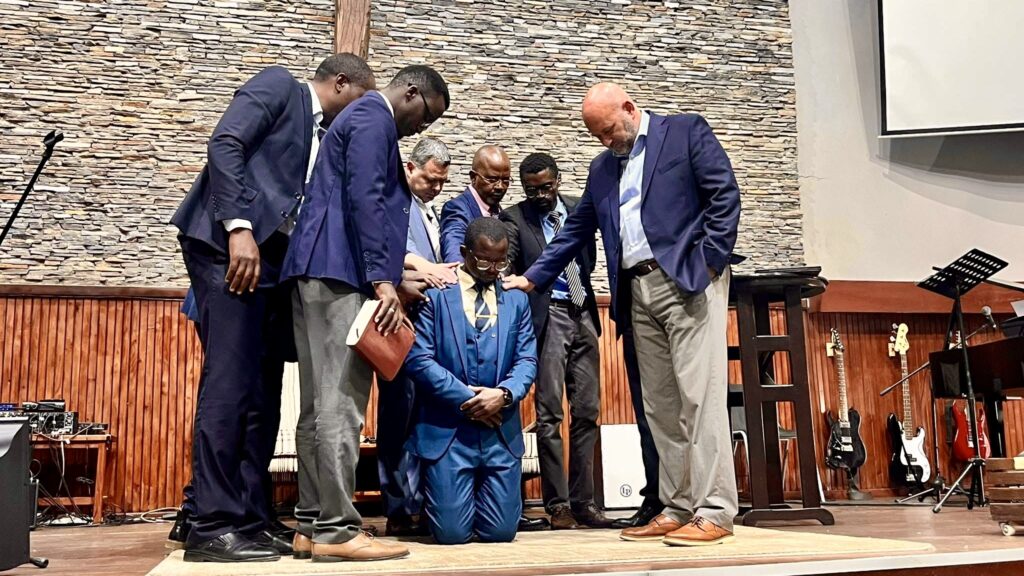
Sunday morning, August 10, 2025. Kitwe Church set apart Lazarus Chanda for the gospel ministry. As a congregation, we have watched Pastor Lazarus’ life, we have examined his doctrine, and we have participated side-by-side in ministry at Kitwe Church.
Lazarus Chanda and his wife Pheobe, along with their three little sons, Talent, Timothy, and Titus Abraham, left this week for the city of Kasama in Northern Province. Survey work has been done, and with God’s enabling, a church will be planted in Kasama Central. This church plant will minister in Bemba, the language most spoken by the people in the area.
Pastor Hector Garcia gave a charge to Pastor Chanda from 1 Peter 5:1-4, and reminded the members of Kitwe Church of their responsibilities. Here is an edited version of that challenge, a challenge that each of us would benefit from receiving.
The Text (1 Peter 5:1-4)
“So I exhort the elders among you, as a fellow elder and a witness of the sufferings of Christ, as well as a partaker in the glory that is going to be revealed: shepherd the flock of God that is among you, exercising oversight, not under compulsion, but willingly, as God would have it; not for shameful gain, but eagerly; not domineering over those in your charge, but being examples to the flock. And when the Chief Shepherd appears, you will receive the unfading crown of glory.”
Prayer
Father, we are grateful for the opportunity to open Your Word. I pray that You would speak to us, You would speak to Your people, You would speak to Your leaders—to the leaders that You have appointed. Father, I pray for words to speak and to say, “Thus says the Lord.” I ask You through the Holy Spirit to communicate, and I pray for hearts and minds that would be opened by the illuminating work of the Holy Spirit. We pray all these things in Jesus’ name. Amen.
Introduction
I want to show you four things from this passage today: the context, the call, the conditions, and the crown—all with a “C” so you remember.
This letter was written by Peter to believers in many cities—people who were suffering persecution. All the believers reading this letter were being persecuted. This letter is important to them because Peter is trying to encourage them. Not only that, but he’s trying to encourage the pastors.
If the believers are suffering, it would be very bad if they’re also suffering because their pastors are bullies. It would be terrible if, on top of their suffering, they would have pastors who are not taking care of their flock well—pastors who would not care for their souls and instead would use them for their own benefit.
After addressing everybody, Peter now addresses the pastors specifically.
1. The Context: An Elder Charging Fellow Elders in Humility
What is the context in which Peter gives this charge? It is an elder giving a charge to fellow elders in humility.
Look at verse 1: “So I exhort the elders among you, as a fellow elder and a witness of the sufferings of Christ, as well as a partaker in the glory that is going to be revealed.”
Peter Identifies as a Fellow Elder
Peter is going to exhort the elders in ministry. As elders and as a congregation, we are charging our brother Lazarus, who is a fellow elder.
Peter is an elder like them. He’s a pastor like them. In this context, he wants to put himself at the same level as them. He says, “I am a fellow elder charging you elders.”
The word “elders” is presbyteros in Greek (plural: presbyteroi). This word is often used in the New Testament to refer to those who had leadership positions in the church.
When we say “elders,” we’re not necessarily referring to old people. It was generally assumed in Paul’s time that elders usually were people of wisdom and experience, so normally they would be older people. But in 1 Timothy, Paul tells Timothy, “Don’t let anyone despise your youth.”
The idea of eldership is someone who has wisdom and experience and therefore is able to counsel properly. A pastor doesn’t need to be old—he must be mature in the Lord and wise.
Peter identifies himself with the leaders of the church by using the same title instead of appealing to them as an apostle. Remember, he was an apostle. He could have said, “I’m an apostle. Listen to me. Here’s my authority. Jesus gave it to me, and you’ve got to do what I say because I walked with Jesus.”
He’s not exercising his apostolic authority per se. Indirectly he is, as he writes under inspiration, but he is putting himself at their level. “We’re fellow elders. Listen to me—I’ve been an elder, and I’m charging you now as an elder.”
Peter Reminds Them of Shared Suffering
Peter reminded them that he was “a witness of the sufferings of Christ.” He’s being intentional because these believers have suffered. He says, “I know you suffered. Jesus suffered too. And all of us have suffered.”
Because believers have suffered because of Christ, and pastors especially had suffered because of Christ, he’s appealing to the sufferings of Jesus. He wants to remind them that Christ Himself traveled the same road, and believers should not be surprised that they are called to do the same.
Pastors will suffer. All Christians will suffer, but there are some things that pastors suffer that most Christians don’t. There are burdens that a pastor must carry that believers don’t have to carry. There are decisions he needs to make, things he needs to know, and applications he needs to make in the lives of people.
If somebody comes to the pastor and says, “Pastor, I’m struggling in my marriage. My husband has been unfaithful. I’m thinking about divorcing,” whatever the pastor says, most likely the person will do. You have to carry that burden.
Brother Lazarus, as you’re going into ministry, you must remember that Jesus Christ traveled the same road. He carried some burdens that nobody else has. We are all partakers of the sufferings of Christ.
Fellow elders, remember that is what the Lord has called us to. You’ve got to have thick skin—you have to have a soft heart, but rhino skin. You’ll be fired at from many angles: “I don’t like the curtains,” “I didn’t like the food today,” “I didn’t like this.” You have to have thick skin, and you’ll be partakers of the suffering of Christ.
Peter Exemplifies Humility
What Peter is doing here is being humble. He never thought of himself as superior. He identified with the elders—with their struggles, their sufferings, their challenges, their experiences, their victories.
Peter is exemplifying humility here. The charge he’s about to give to fellow elders is done in a spirit of humility. He wants his readers to understand the importance of being humble.
He did not act like a Pope. Catholics think he’s the first pope, but he didn’t say, “I’m speaking ex cathedra from my chair, making no mistake because I’m the first pope.” He spoke in humility. He identified with their suffering. He was not being a “big papa.” He was a fellow elder.
Peter exemplifies here the most basic attitude and requirement of an elder: humility. There’s nothing more important than that. Elders must be humble. Humility should be a mark of our ministries.
People should not believe and think that you are holier than thou. You should not mistreat people. You should not use people to your advantage. Humility should be a mark of your ministry.
Brother Lazarus, listen, and all of you fellow elders: You don’t have to be special. You don’t have to be so cool. You don’t have to be up here for everyone to see you. You don’t have to be the most talented. In fact, sometimes it’s better if you’re not. But you do need to be humble.
Pride will destroy you. Pride will destroy your family, your ministry, and your church. This is a call for you to never feel superior, to never feel like you’re better than others because of your position, your gifting, or the privilege you have to serve Jesus.
Peter’s attitude should be your attitude in every conversation and every interaction with the people you serve.
2. The Call: Shepherd the Flock, Exercising Oversight
Look at verse 2: “Shepherd the flock of God that is among you, exercising oversight.”
What is the call? Shepherd the flock, exercising oversight. That is the ultimate call of a pastor—to shepherd, to be a true pastor, to be the leader of the sheep, to care for the sheep.
What Does It Mean to Shepherd?
We use this word “pastor,” and it is an analogy. Even in the Old Testament, God would call the leaders shepherds. But what does that involve? What does pastoral work involve?
Shepherd the flock means care for the sheep. If a sheep is wounded, if a sheep needs help, you provide spiritual healing through counseling.
Sheep are very needy animals. They are not very smart, and all of us are sheep. We go astray easily. They need feeding, water, shearing, and care. Sheep require a lot of care, and that is what a pastor is called to do.
Guide the Sheep
A shepherd must guide the sheep. You show them and keep them in the way so they do not go astray. Sheep easily go astray—you can ask any shepherd. They get lost very easily because they’re sheep.
Bring Back the Stray Sheep
As a shepherd, you bring back the stray sheep. You’ve got to keep them in the way, guide them, but you’re going to have sheep that go astray.
“Your rod and Your staff, they comfort me” (Psalm 23:4). The shepherd would get that staff with the hook and bring the sheep back. The sheep is going out of the way—bring it back to the way. That’s what a shepherd does.
Feed the Sheep
A shepherd feeds the sheep. You do this as you teach and preach God’s Word faithfully. You find the best green pastures for them, not just any food. You don’t keep your sheep starving.
Brother Lazarus and all of us pastors, I hope you would never get up on a Sunday morning and say, “Oh, what am I going to preach today?” That would be very shameful. You prepare the food. Then you taste it first—make sure it goes into your heart as well. Then you give it to the sheep, because it is the job of a pastor to feed the sheep and keep them well-fed.
There are many churches where the sheep are actually starving because they haven’t been fed. When people come from a church that hasn’t been preaching the Word of God well, they come and say, “I just didn’t realize how hungry I was for the truth.”
You’ve got to make sure you prepare the food well.
Protect the Sheep
Finally, protect the sheep. Brethren, many wolves will come, and we are surrounded by wolves. Jesus said, “I send you like sheep among wolves.” But you protect the flock from false teaching.
Protect the flock because the wolves will try to deceive your sheep. They’ll try to tell them that Jesus died so they can be rich, that Jesus died so they can be healthy. They will lead your sheep astray and devour them.
Brother Lazarus, as you go to Kasama, you’ve got all those religious groups. The Jehovah’s Witnesses with their false doctrine will come. They seem very good, very religious, very caring. They’ll come and do a Bible study, but you protect the sheep from the wolves.
The prosperity gospel preachers will bring their big speakers, their nice Italian suits, and they’ll be so flashy and sound very powerful. “In the name of Jesus, I cast out every demon.” They sound very cool and powerful, and they’ll deceive the sheep. Protect the sheep from the wolves.
The Cost of Shepherding
This is a monumental responsibility, brothers. This is what we’re called to do as shepherds:
- You will be cold, but you must keep the sheep warm
- You will be hungry at times, but you must keep the sheep fed
- You will be afraid sometimes, but you must keep them safe
- You must always know the way because you must guide the sheep
- You must feed yourself so that you can feed the same food to the sheep
It is a task that you do not enter into lightly because you will give an account to God for the sheep.
A Word to the Church
Now church, this charge is for you: Don’t make the pastoral work more difficult than it already is.
Instead of criticizing your pastor, encourage him. Encourage Brother Lazarus. Pray for him. Be financially generous. You might demand a lot from your pastor and the church, but you’re not faithful in your giving, praying, or encouraging.
Be caring, don’t be overbearing. Be holy, so you don’t have to be one of those sheep that always wants the pastor’s attention—the sheep that keeps going astray and the pastor keeps pulling you back.
There are some sheep that really love attention. Can’t you just stay on the way? Church, help your pastors as they pastor the flock. Help your shepherds to shepherd faithfully. We need your help. We’re not perfect. Pray for us so that we can do faithful work.
God’s Flock, Not Ours
One thing I find interesting in verse 2 is that the text says, “shepherd the flock of God that is among you.” Whose flock is it? It is God’s flock.
Peter reminds the elders that the congregation does not belong to them. It is God’s church, and the pastors are given the privilege and responsibility of shepherding it.
Many so-called pastors today act as if the church was theirs, as if the congregation was there to serve them and do what the pastor says. “All these people exist to make me rich and comfortable, and I need a new jet.”
Kenneth Copeland already has jets and says he needs a bigger one because he can’t fly with “a bunch of demons” (referring to commercial airlines). I genuinely think he’s demon-possessed. He thinks the church exists for him, and there are many pastors like that who abuse the flock.
No, it is God’s flock.
Three Terms, One Office
The text tells us that a shepherd must shepherd the flock by exercising oversight. This speaks generally to managing the affairs of the church. You must shepherd the flock as an overseer, as one who’s aware of what is going on in the flock.
There are three terms used here: elders (presbyteros), pastors/shepherds, and bishops/overseers (episkopos). The Presbyterians get their name from the first one, the Episcopalians from the third one.
These three terms refer to the same office. In the Bible, they refer to the same office. It’s okay to call your pastor a pastor, an elder, or a bishop because a pastor is fulfilling these three responsibilities.
When you refer to your spiritual leader as:
- An elder: You’re emphasizing his spiritual maturity, wisdom, life experience, knowledge of the Bible, understanding of faithful biblical doctrine, and the honorable example he sets
- A bishop: You’re emphasizing his leadership, vision, watchfulness over the healthy operations of the church family
- A pastor: You’re highlighting his loving care for the needs of the church and all members, his ability to minister to those in need, his work as a counselor, and his faithfulness to feed them from the Word of truth and defend the flock from error
All three terms speak of some aspect of the pastor. You might be stronger in one of the three, but you still have to do all three of them.
Brother Lazarus, God has issued this call to you. For you, for me, and for every other pastor here, take it seriously. Give your life for the sheep. Feed them, protect them, care for them, and if need be, die for them. For it is a flock of Christ, and He Himself died for them.
3. The Conditions: How to Shepherd Faithfully
Condition 1: Willingly, Not Under Compulsion
Look at verse 2: “Shepherd the flock of God that is among you, exercising oversight, not under compulsion, but willingly, as God would have it.”
The first condition is don’t do it under compulsion, but willingly.
It is true that men in ministry should meet very strict qualifications laid out here and in 1 Timothy 3 and Titus 1. There are conditions for a man to be in ministry, but none of that matters if you do not have a desire to be in ministry.
1 Timothy 3 gives the most comprehensive list of qualifications, but before laying out the requirements, Paul says, “If anyone aspires to be an overseer, he desires a good work.” He begins with the desire.
Peter says, “Don’t do it under compulsion. Don’t be forced into it.” Before we even talk about qualifications, we must make sure the pastor has a passion and consuming desire to serve God in ministry.
He must be a man that can’t see himself doing another thing. Not “I’m pastoring because there’s no one right now, but my real calling is to be an engineer,” or “This is interfering with my doctoral career.” This must be a consuming passion and desire for the pastor.
Peter says, “as God would have you” or “as the will of God is for you.” This means that your will must align with God’s will. If He desires you to be a pastor, you will have a strong desire to be a pastor.
I have met men who meet the qualifications of 1 Timothy 3, Titus 1, 1 Peter 5, and Acts 20, but they don’t have a desire to be a pastor. They don’t think God has called them.
We live in an age where Christianity is so weak sometimes that when we see a man who loves Jesus, we think immediately that he must be a pastor. Actually, all of us should live meeting the qualifications of 1 Timothy 3. It isn’t just for pastors—all of us should be humble, not quarrelsome, not given to much wine, not lovers of money. All of us should meet those qualifications, but the pastor must have a desire.
Sometimes pastors are there because there was a need. “The church needed a pastor. I stepped up because everybody pushed me into it. I was a deacon, but everybody pushed me into it. I had to be a pastor because there was a need.”
Here’s the problem: The need does not supersede God’s commandments. If the man does not want to be in ministry, he shouldn’t be there. “Not under compulsion, but willingly as God would have them.”
There are also men who become pastors because their father was a pastor, or their relatives were pastors, and it is expected of them. Then they became pastors and were miserable—and so are the people they’re serving.
A pastor must serve willingly.
Condition 2: Not for Shameful Gain, But Eagerly
This means that a pastor should be in ministry because he wants to serve the Lord, not because he wants to serve himself and get a financial benefit.
There are some who go into ministry because they want to find a church that will give them a good, safe, secure salary. That is shameful gain.
In 1 Timothy 3, we’re told that a pastor must not be a lover of money. Sadly, that is how most pastors are in our day and age.
If you grab a fishing rod and put a 500 kwacha bill on the hook and show it to some prosperity gospel pastors, you’ll reel in a lot of them because that’s what they’re fishing for.
A true man of God should be in ministry serving eagerly, not for financial gain.
How Do You Know a Pastor Who Loves Money?
- He’s always asking for more money for himself
- He gets upset if he doesn’t get it
- He won’t start preaching until the baskets are full
- He’s not willing to sacrifice for the good of the flock
- He’s not very hardworking or generous
- He constantly talks about money and “sowing seeds”
- He charges members for his services such as prayers and special events
I led a lady to the Lord many years ago because a “man of God” came to pray for her. She kneeled before him and put down some money for him to pray for her. He said, “Is that how much you value the prayers of a man of God?” He wouldn’t pray until she put enough money down.
A Word to the Church
I don’t believe that a church should ever ask a man to serve as their pastor without also promising or making sure that the pastor is well taken care of, because that is a church’s responsibility.
I’m grateful for this church that’s always willing to help its pastors if needed. You must always be generous and willing to help your pastors. You must always sacrifice for the work of the gospel, just as a pastor must sacrificially give of himself to the task.
We must all take the responsibility of taking care of Brother Lazarus so that he can be serving the Lord in ministry.
Fellow elders, don’t serve for shameful gain.
Condition 3: Not Domineering, But Being Examples
This means that a pastor should not be a bully. He should be an example of meekness and humility.
A pastor’s position is one of authority. He commands respect and people usually respect and obey them because of their position. But rather than using this position to oppress or lord over the flock, a pastor must be an example of service and sacrifice.
This doesn’t mean that a pastor should be perfect, but he should be an example worthy of following.
A pastor cannot be a bully. Peter was an apostle, one of the 12, a leader of the 12, and he calls himself a fellow elder. He doesn’t lord over them. Peter didn’t demand respect.
A leader who likes to control others, who loves to exercise power over people and demands that everything be done his way, who is short-tempered, is a terrible burden for a church.
Remember Diotrephes? In 3 John 9, John says: “I wrote something to the church, but Diotrephes, who loves to have first place among them, does not receive us. This is why if I come, I will remind him of the works he’s doing, slandering us with malicious words. And he’s not satisfied with that. He not only refuses to welcome the brothers himself, but then he stops those who want to do so and expels them from the church.”
You must be a man who is not a bully, not domineering, but being an example.
4. The Crown: The Eternal Reward
Look at verse 4: “And when the Chief Shepherd appears, you will receive the unfading crown of glory.”
Peter ends by giving the shepherds hope. He’s not calling them to serve and sacrifice without a reward. He reminds them that our crown, our reward, is coming soon when we meet the Chief Shepherd in glory.
Jesus is the Chief Shepherd
It is a reward that is awarded by the Chief Shepherd. Jesus here is called the Chief Shepherd—a rare term that only appears here.
By calling Jesus the Chief Shepherd, Peter reminds us that we as leaders are servants, not bosses. We have a boss. We have a head.
As shepherds, we serve under the authority of the Chief Shepherd. Brother Lazarus, you are an under-shepherd. Shepherds, we are under the Chief Shepherd. All of us are under Him.
Pastors, you’re not Jesus. You work for Jesus.
As shepherds, we advance the agenda of Jesus, not our own. We advance His kingdom, not our own.
An Eternal Crown
It is an eternal crown. The Bible says here it is unfading.
In the old times, especially in the games and competitions like the Olympic Games, a crown would be given to the winner. If a person won a race or fight, they would be awarded with a crown made of leaves—a wreath made of leaves and flowers. That was a perishable crown.
For us shepherds, there is a crown waiting in glory that is eternal. Your labor is not in vain. There is a reward that is coming.
Jesus will reward and honor someday all pastors who serve well, all pastors who serve according to the conditions we just learned. And this reward is forever.
Conclusion
I conclude with these words. Brother Lazarus, all of us pastors, and all of us church, listen to this.
1 Corinthians 15:58 says: “Therefore, my beloved brothers, be steadfast, immovable, always abounding in the work of the Lord, knowing that in the Lord your labor is not in vain.”
Closing Prayer
Father, I pray that You help all of us, especially the pastors here present, to shepherd like the Chief Shepherd—like the one who gave His life for us, like the one who cared for us, like the one who died for us. I pray that we would die for the sheep, that we would care for the sheep, that we would feed the sheep for the glory of Your name.
I pray for Brother Lazarus as he stands before us to be ordained, that he would take this call seriously—this call that is issued to every man that God has chosen to serve Him in ministry.
Thank You, Father, for giving us these commandments. I pray that we would be faithful to You. In Jesus’ name. Amen.